

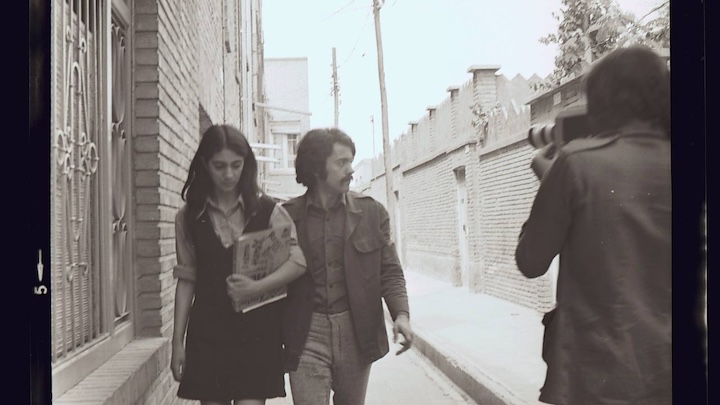
By Hadi Alipanah, Arta Barzanji, and Shaghayegh Raoufi
Cinema-ye Azad was an oppositional cinema movement founded in 1969 by Basir Nasibi against both the commercial and state control of the film industry in pre-revolution Iran. Of the many filmmakers associated with the movement, the work of Behnam Jafari stands out for its formal ingenuity. His films, produced primarily in the early to mid-1970s, pushed the movement’s commitment to autonomy towards a distinctly authorial and technically self-sufficient practice. As Jafari himself reflected in an interview with Ettela’at newspaper:
“The 8mm frame creates possibilities for an amateur filmmaker. An 8mm filmmaker can make a film without a technical crew. The filmmaker writes the script and directs, shoots, and edits the film alone, without interference from others. Since I am interested in all stages of filmmaking, I prefer to carry out every stage of producing my films myself. It was a kind of collaboration between me and the camera—we moved forward together, recording the image we desired.”
Jafari developed a body of work that combines formal experimentation with a sharp social sensibility. His films repeatedly return to themes of alienation, fragmentation and the pressures shaping everyday life in pre-revolutionary Iran, approaching these concerns through strikingly different cinematic registers.
Abandoned Heights (1972) exemplifies the rigour of Jafari’s filmmaking. Centred on the interactions between a thief, an older man and a young trumpet player, the film explores isolation and fragmentation through a precisely constructed interplay of image and sound. The recurring trumpet operates as an insistent call, cutting through the film’s atmosphere and lending its societal tensions a particular urgency.
The other films in the selection demonstrate the remarkable range of Jafari’s short-form practice. Tell the Watchman Not to Let Sleep Deceive Them (1973) employs a tightly controlled visual perspective to foreground social distance and observation. Scream (Vol. 2) (1972) adopts a reflexive and satirical mode, turning towards cinema itself in a critique of cinematic conventions and Filmfarsi. Let Us Live (1973), meanwhile, captures generational anxiety through an oneiric and affective visual language. Taken together, these films reveal a filmmaker continually testing what could be achieved within the material constraints — and possibilities — of independent 8mm filmmaking.
Alongside Jafari’s films, the programme presents Nasib Nasibi’s From Isfahan to Abarkooh (1970), a documentary journey along the Isfahan–Shiraz route in which historical sites are approached not simply as monuments or backdrops, but as living carriers of memory, ritual and myth. At the Shah Abbas caravanserai in Mahyar, once described as “the Kaaba of distant caravans”, a boy running through the empty courtyards seems to stir the abandoned structure from its silence, conjuring the clamour of a vanished past. The journey continues to Shahreza, where the camera moves from the threshold of a turquoise-domed shrine to the pilgrims gathered outside and finally into the tomb chamber, where prayer and recitation unfold. At a nearby Seljuk-era site, Nasibi documents a chain-flagellation ritual, while at the Shah Abbasi caravanserai in Aminabad, elderly men read from the Old Testament, evoking the region’s layered religious history.
Yet Nasibi’s film does not remain within the conventions of the historical or ethnographic travelogue. Documentary observation gradually gives way to oral narrative, poetry and myth. Nasibi’s mythopoetic style – apparent also in How Frightening Is the Darkness of the Soul – deploys poetic cinema to visualise vernacular myths. Local stories transform ruins and landscapes into repositories of lived history: ancient fortresses bear witness to forgotten acts of valour; a well contains a sealed story; a blind elderly man recalls wars, conquerors and rulers. Nasibi moves between recording places as they existed in 1970 and evoking the histories, legends and memories through which those places continued to live. The landscape becomes an archive, its surviving structures carrying traces of worlds that have otherwise disappeared.
Cinema-ye Azad – Further Explorations screens Friday at the Barbican, followed by a Q&A with archivist Hadi Alipanah.