

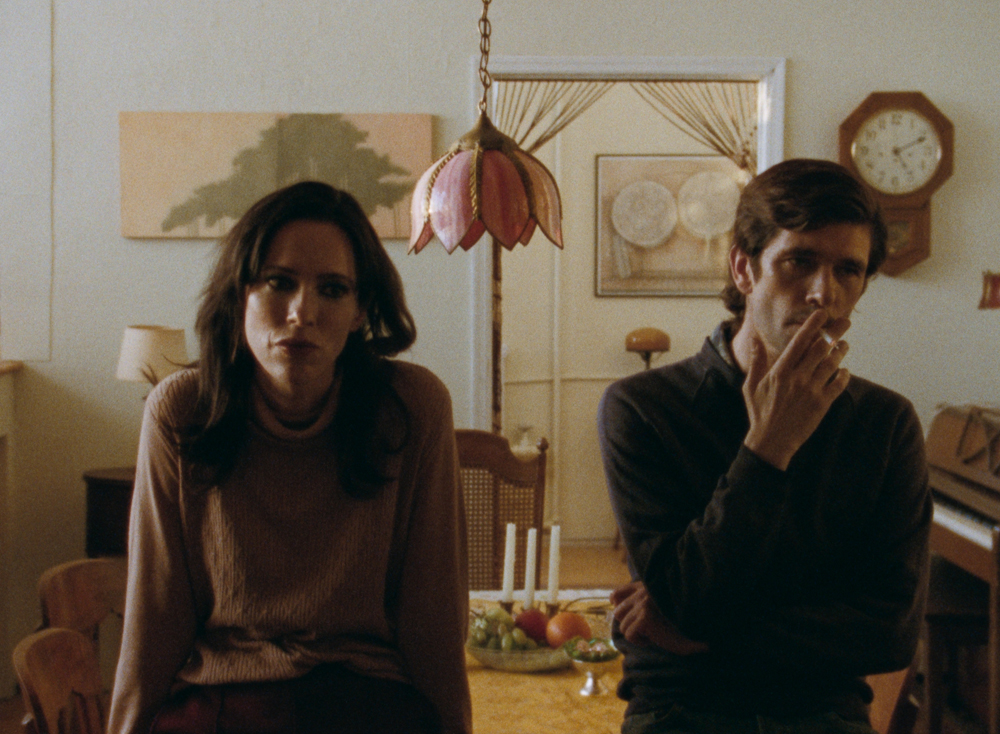
Andrew Sachs’ Peter Hujar’s Day (2025)
by Joseph Richards
Was Josh Safdie somewhere over the Atlantic? Was Timothée Chalamet in Soho? Was Marty Supreme really going to be the London Film Festival’s Surprise Film? The speculation that comes with the festival’s mystery screening each October is only partly to do with the allure of the unknown. Too late to claim major premières like Cannes or Venice, smaller than Berlin or Toronto, and less discerning than New York, London is awkward. And so the Surprise Film becomes a receptacle for what you wish the festival was. On Christmas Eve the presents under the tree can be everything and nothing. Maybe your friend did see Timmy in Rowans.
He had been in town the week before, slipping into the balcony at Odeon Leicester Square just before the lights went down on One Battle After Another, but Marty Supreme was headed west for a special LA screening for Academy members. The assembled suckers in the Royal Festival Hall had to settle for Tuner, Daniel Roher’s fiction-feature debut, following a savant piano engineer who discovers his sensitive ear can be used for bad as well as good when shady safepickers offer him the chance to make a lot of money fast. A great surprise film in the sense that no one had previously heard of it. A bad one in that no one has heard about it since. A film that, at the time of writing, only two other people on my Letterboxd have logged — one of them Sean Fennessey.
In the festival world at least, geography is still destiny. London might not interest America, but London is very interested in America. In the loftier reaches, Netflix’s imprint on the festival is unmistakable. The streamer is an “Industry Supporter” alongside other US tech disruptors. Amongst the Gala screenings, Mubi stands alone as a significant non-US bulwark, offering Die My Love, its tentpole acquisition, and Reichardt’s Mastermind, alongside the new Panahi, Sentimental Value and No Other Choice, shared with Neon. Such are the realities of the film industry in 2025, not to mention the cost of running a film festival. It’s the same everywhere: at NYFF the euphemism for Netflix’s involvement is “Supporting Partner”, but only in London does something like Wake Up Dead Man: A Knives Out Mystery receive the honour of opening a festival a few short weeks before it’s dumped onto streaming.
Special dispensation can be made for the festival’s remit of championing domestic talent — or at least Daniel Craig and Josh O’Connor — but the same leniency can’t be extended to other Netflix titles: holdovers from Telluride (Ballad of a Small Player), Venice (Jay Kelly), Cannes (Nouvelle Vague) and Toronto (del Toro’s Frankenstein), which are also granted Headline Galas. From its humble beginnings in 1957 as a “festival of festivals,” handpicking a programme of fifteen titles that represented the choicest picks from the European Spring/Summer catalogue — including, mind-bogglingly, Throne of Blood, A Face in the Crowd, The Seventh Seal, and The Nights of Cabiria — London now has the veneer of a polished pre-release window for the entertainment wing of US tech capital. Days after the festival ends, the Underground fills with ads for the company’s holiday slate, proclaiming “A Season of Visionary Directors.”
LFF is big and sprawling, which has its populist charm. The festival offers a thorough portrait of moviegoing in the city. Unlike New York, mostly hemmed into Manhattan’s Lincoln Center for the Performing Arts (imagine a bigger Barbican on a bigger Hyde Park), the festival gets around. Reduced from the days of the scaffold spomenik of Embankment Garden Cinema, when an ambitious itinerary might’ve required a sprint from Hackney Picturehouse to the Institut Français, it still offers a chance to slip into venues you would rarely visit otherwise; to watch something as recherché as Dry Leaf from an electric recliner in a Vue, to be reminded that maybe you should splash out more often to see stuff in Curzon Soho.
Many moons ago, the Festival introduced me to NFT1 through a screening of The Artist. Inconspicuous beginnings, but the habit stuck. Since then, October has meant return-queue camaraderie, leftover press tickets gifted by benevolently negligent box-office staff, and nail-biting Q&As. What I was seeking, beyond an education and cultural remediation, was something of the exclusivity and sense of discovery that the original big tech streamer Spotify dented with my adolescent obsession with music. In other words: a chance to be a snob with something new. At the London Film Festival, I found it. Any jadedness toward its offerings in 2025 is a consequence of it reaching out to me over a decade ago with something that went like gangbusters for a twenty-something who had never seen Singin’ in the Rain: the pseud-to-snob pipeline that Netflix imperils but has not yet taken away.
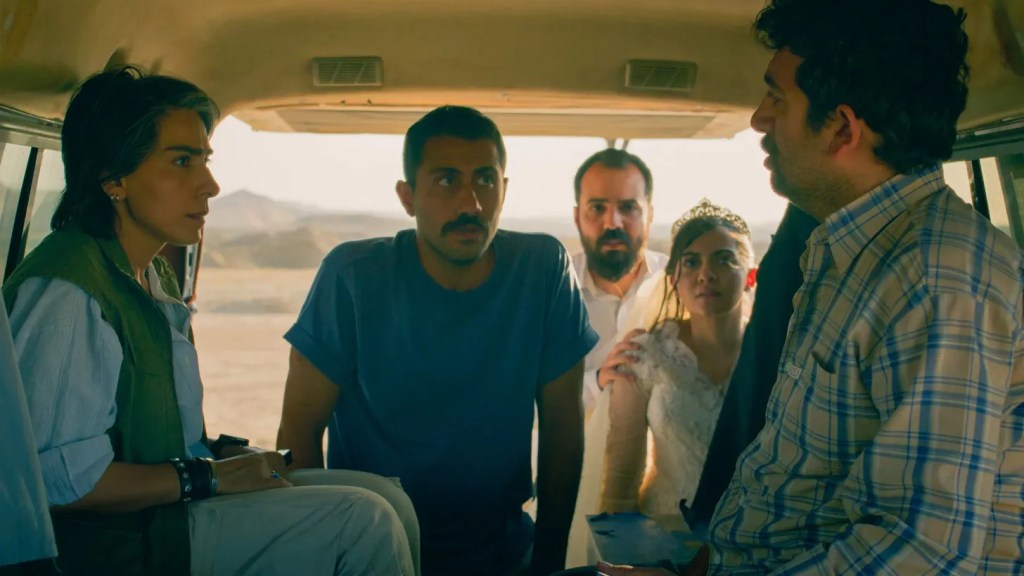
Jafar Panahi’s It Was Just an Accident (2025)
From Kevin B. Lee’s Afterlives—a Farockian desktop documentary borrowing from the myth of Medusa to illustrate how extremist propaganda permeates the internet and our psyches—to Lav Diaz’s Magellan, a heavily annotated Great Man* biopic that undermines its subject with postcolonial marginalia, tackling History, the life of the man, and the conventions of the genre: the ways in which form and format do more than change the shape of something was a recurring preoccupation in London. A worthwhile enterprise in life under Big Streaming.
These complications of history and identity were at the forefront of my mind watching Jafar Panahi’s It Was Just an Accident. The film is put into motion by chance. A car hits a dog on the road — “all part of God’s plan,” the driver’s wife insists. They pull into a garage, where a mechanic becomes convinced the driver is something worse than a dog killer, but an amputee prison guard known as Peg Leg, who meted out scars physical and psychic on his charges. Sensing his own kind of providence, the mechanic kidnaps him before driving out into the desert, intending to kill him.
From a half-filled grave, the driver insists he’s got the wrong guy — as you might — pleading that his wound is recent, and not that of the Iran-Iraq War veteran the torturer boasted of being. Doubt creeps in; the revenge plot becomes a more fraught story of crime and punishment and the traumas of political repression. “Peg Leg” goes back into the van, and the mechanic, Vahid, takes a cigarette break. Back in the city, he enlists a motley group of other former prisoners to help work out if the man in the boot is who he thinks he is, and, if so, what they should do with him. All blindfolded through much of their incarceration, a tactile, olfactory hermeneutics takes over, smell and touch filling the gap left by sight.
It Was Just an Accident folds the playful truth-probing found in No Bears and This Is Not a Film into a more classical narrative with a keen gallows humour. That turn reflects Panahi’s interest less with the truth of who the man in the van is, than the claim the past has on the present. The ambiguity of Rashid/Peg Leg opens up a space for moral inquiry. The crew argue and talk of their lives before and since their imprisonment. Complexity and nuance accrue, before the film ends on an uncommonly dark note for Panahi, one suggesting limits to the reconciliation and humanism that has previously marked his work.
The stakes of understanding and memory were lower in Peter Hujar’s Day, but just as intimately tied to survival. In December 1974, the photographer (Ben Whishaw) spent a day recounting the previous day to his friend, the writer Linda Rosenkrantz (Rebecca Hall) for a book she hoped would capture the quotidian of the life of the artist. The tape of the conversation was lost, and only in 2019 did a full transcript resurface. Sachs’s film restages that transcript almost verbatim, performing a restaging the photographer’s restaging of his 18th of December on the 19th.
Sachs limits that meta quality to flaunting the beginnings and ends of reels and showing off the odd clapperboard. Instead, the film hews closely to the conversation. Nothing of Peter’s telling of the day is illustrated; we stay within the bounds of Rosenkrantz’s swank UES apartment. Truth becomes a matter of attending to the tone and rhythm of talk; the conversation drifts, breezy and dishy as chats between friends tend to be. Susan calls, Peter wants her to write a foreword for a collection of photography; the pair decry the self regard of Allen, a hokum poet-mystic, and the sexual peccadilloes of William, a novelist with an interesting face and a penchant for WASP-y young boys. Beyond the gossip, mundanity rules: he loves liverwurst sandwiches, hates that cigarettes are now 56¢ a pack; a coffee mug filled in the sink is his preferred way to water his plants. On the other end of this stream, Rosenkrantz is a patient, attentive listener; the film shares her approach, portraying the texture and longueurs of a time and place over grasping at the capital-H history that surrounds them.
Peter Hujar’s Day is hangout cinema by way of Frank O’Hara and the talkier films of Andy Warhol. Like the work of these fellow New Yorkers, part of its project is an attempt to estrange the familiar. Cinematographer Alex Ashe, fresh from The Ballad of Suzanne Césaire, racks focus in a way that mimics the promiscuity of prose or the capriciousness of looking. Light shifts around Rosenkrantz’s apartment, aligning the hour-by-hour quality of Hujar’s retelling with a sublime beyond the clock, an echo of another modernist: the leaden circles described by Woolf’s Big Ben in Mrs Dalloway. Morality and the march of time cast their shadows on everything.
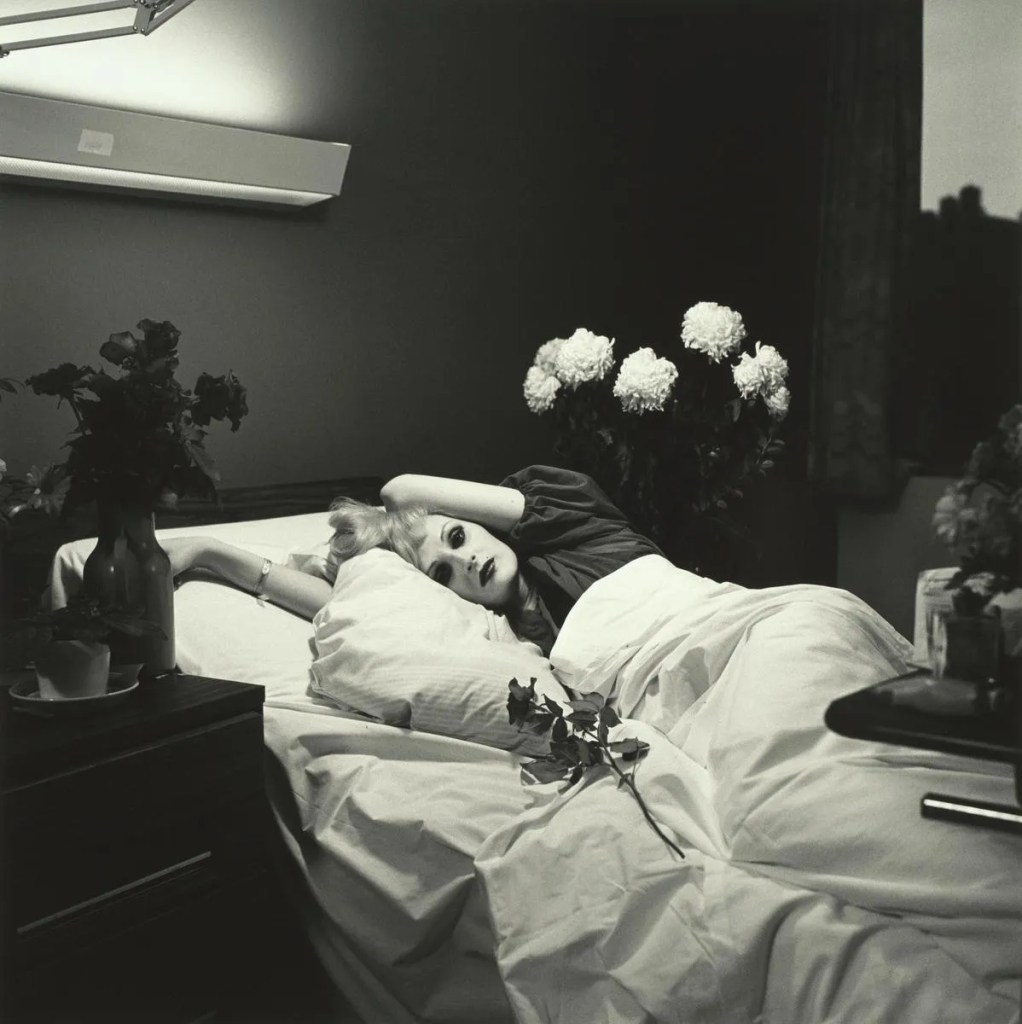
Peter Hujar’s Candy Darling on Her Deathbed (1973)
From his most famous photograph, Candy Darling on Her Deathbed, to the one collection of his photography published in his lifetime, Portraits in Life and Death, Hujar’s own work was preoccupied with the thin veil between the hubris of self-presentation and the beyond. In the latter, he juxtaposes portraits of bodies in the Palermo catacombs, their clothes vainly clinging to bone, with portraits of the great and good of New York bohemia. In the film, recently turned forty, he expresses dismay over a new near-sightedness; Rosenkrantz mothers him about his diet and smoking habit. Sachs’s attempt to echo that sensibility, to produce a memento mori, beyond registering the passing of time and reproducing the pair’s own mordant conversation, is responsible for the film’s one glaring misstep. Leaving the confines of the apartment and the 19th of December, there’s a brief interlude of funeral images set to the Lacrimosa from Mozart’s Requiem — an attempted gesture, presumably toward the AIDS crisis that would claim Hujar a decade later — which leaves the film momentarily stranded, attempting to ride the coattails of an over-familiar, mammoth work, contrary to the film’s minor, diaristic mode.
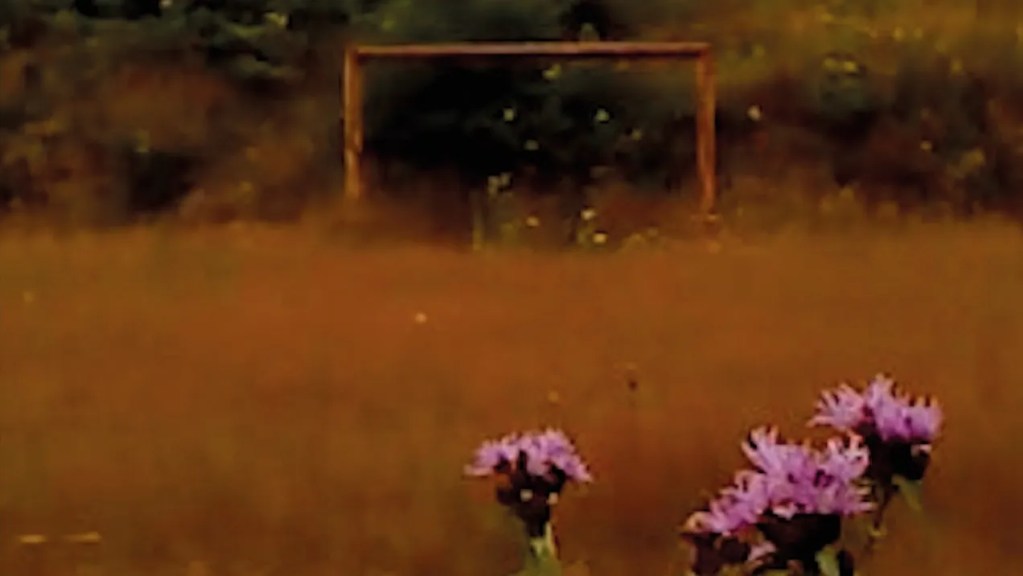
Alexandre Koberidze’s Dry Leaf (2025)
On the same Saturday, before a brief break for fresh air and conversation, it’s soon time to head straight back into the Vue West End. Alexandre Koberidze’s Dry Leaf seems at first to promise something more straightforwardly cinematic: a father searching for his missing daughter, a sports photographer who has apparently gone AWOL whilst on a project documenting football pitches across Georgia. Followers of Koberidze won’t be surprised to learn the film is far from a Taken-type action thriller, but instead concerned with the act of looking itself.
The film uses the father’s winding, Odyssean road trip to mount a provocation. Shot on Koberidze’s trademark outdated phone camera, a device with a limited capacity to reproduce the world beyond its lens, the film melts into a digital pointillism, Seurat presented by the Sony Ericsson, which calls into question the ability of the camera to represent reality. Within that digital murk, in its long, plaintive shots tracking the journey of a car through the Caucasus, viewers of a certain vintage might be reminded of the genre of jump-scare videos, a menace from a time when the internet was a more trusting place. A more highfalutin’ comparison could be made with the later work of Godard, which shares with Dry Leaf — and Scary Car Commercial — a similar preoccupation with the potential of the degraded image of early digital photography to foster a healthy, liberating scepticism towards the images that not only represent but comprise so much of our sense of the world.
Unlike Peter Hujar’s Day, this scepticism extends into language. We’re gifted a narrator, a voice who fills in what the image can’t show, but who delights in misdirection. An early, under-exposed frame appears to hide two characters we’re told are present; only later, in a shot/reverse shot, the basic unit of classical cinema’s legibility, do we discover that one of the pair is literally invisible. There, but not. Allowing for translation and the idioms of Georgian, a black-and-white dog is named Panda; someone is told to “fly like a buffalo”; a teacher draws a white mark on a chalkboard, and when a student identifies it as a stick he’s told wearily that, no, it’s just a line. The father’s quest to find his daughter, who may be missing, or simply not wanting to be present, turns on locating a football pitch he once visited with her — a space that should be simple to describe, but like the chalkboard sketch, continually slips from definition. Unlike a gymnasium, one of the film’s recurring settings, more concretely defined by the equipment of pommel horses, parallel bars, and the like, a football pitch may be a football pitch, but sometimes it’s just a patch of grass. Over a fleet three-hour runtime, Koberidze suggests that even the plainest things evade easy definition, and that the act of looking is always fraught with ambiguity, delight, and play.
Blue Heron, Canadian filmmaker Sophy Romvari’s feature debut, expands on the concerns of a short-form body of work concerned with grief, loss, the archive and the fraught therapeutic functions of art. It begins deceptively as a semi-biographical coming-of-age drama, following a young Hungarian-American family settling on Vancouver Island in the late ‘90s, when their eldest son acts out with escalating severity, veering from adolescent misdemeanour to criminal and homicidal threats for reasons unclear to us. An obscurity mimicked in the film’s form, which takes up a roving, voyeuristic quality: family scenes are framed through windows, hidden by the architecture of the home; long-lens shots make the camera’s technological mediation, its limitations and preferences, overt. A process dramatised by the father’s interest in photography and the presence of the youngest daughter Sasha, Romvari’s sad-eyed surrogate — the portrait of the artist as a young girl. When Jeremy returns home in cuffs midway through the film, the family rushes to greet him. All except for Sasha, left holding a discarded home-video camera of a similar vintage to Koberidze’s Sony Ericsson.
Then the film ruptures. We’re flung into the present, announced by the sudden appearance of another image-making technology, the iPhone. Sasha is now an adult, holding court over a seminar room of counsellors, presenting a case-file analysis that reframes the family drama we’ve just witnessed in the presumptive objectivity of the clinical-pathological. A documentary mode takes over – cool colour grading, speakerphone conversations, and other visual grammars of institutional and generic truth-making. To say more than that the film’s line between fact and fiction blurs would be to spoil it. It’s enough to say Blue Heron is a nimble work that ruthlessly interrogates its own premises in a way that doesn’t undercut its considerable emotional heft but deepens it.
Khalil Joseph’s BLKNWS: Terms & Conditions takes these epistemological and formal inquiries to broader issues of race, history and cultural memory. Adapted from a two-channel Venice Biennale installation, it takes the energy of Joseph’s background in music videos into an essayistic mode that interrogates the ways in which racial identity is established, reproduced and circulated. The work starts modestly on a desktop screen, from which a tabbed biography of Joseph; his late brother, the artist Noah Davis; the sociologist W.E.B. Du Bois; and the Africana Encyclopedia, the lifelong toil of Du Bois, spools out before a record scratch and a winking disclaimer (“this is not a documentary,” punctuated by the famous RelivedDenzel GIF) bursts the remedial tone and snaps the film into a more playful mode.
What follows is a propulsive, house-music-driven collage: an annotated bibliography of the Encyclopedia, poetical and associative, capacious and promiscuous in its adulation. One that draws equally from the stentorian and silly, the high and lowbrow, the classical and the vernacular, “I Have a Dream” and “Back at it Again at Krispy Kreme”; Arthur Jafa, a credited collaborator, and his work Love is the Message, The Message is Death is an obvious touchstone. It’s a tone familiar to anyone acquainted with the millennial internet of Tumblr and Black Twitter. One might wonder what is being celebrated in Blackness when figures as diverse as Louis Farrakhan and Barack Obama are held up in the same breath, but its effort is corrective, a starting point for further inquiry, illuminating a constellation with blackness as its common denominator. In its most kinetic moments, the cuts are quick enough to hold off introspection. It goes down easily, and you’re roused enough to watch without stirring yourself to add dissenting marginalia.
At the heart of BLKNWS is the Afrofuturist chronicle of The Nautica, a futuristic liner tracing a return across the Middle Passage. Here the speculative displaces the encyclopaedic. Critical fabulation, a concept developed by Saidiya Hartman — another collaborator — is an influence; a method that explores the “what might have been” of lives not lived, literally and figuratively. Talking to The New Yorker to publicise Lose Your Mother, Hartman noted that there is not one extant autobiography of a female slave who survived the journey across the Atlantic. Conjuring truth in the absence of fact is a problem threaded through BLKNWS and the festival as a whole, one that finds solutions in fresh modes of representation.