

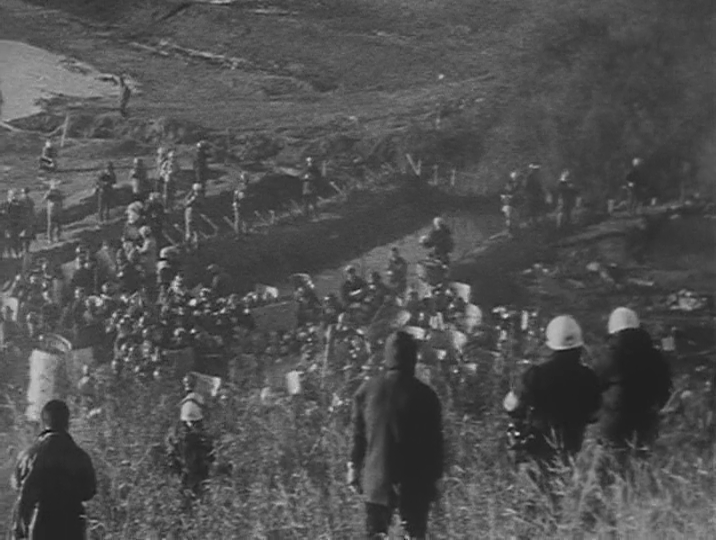
In 1966 the Japanese government announced the building of an international airport north-east of Tokyo at the town of Narita, its construction involving the levelling of farmland and several villages in an area called Sanrizuka. What followed was a protracted period of civil disobedience and riots between the Japanese government and farmers, leftist groups and students opposed to the expropriation of the land. Later known as The Sanrizuka Struggle, the conflict attracted the attention of Shinsuke Ogawa, a documentary filmmaker preoccupied with the struggles of the New Left in Japan. Having previously made three films on the 60s student movement, his Ogawa Productions would produce seven films in nine years on Sanrizuka, referred to as the War and Peace of world cinema by film historian Abe Mark Nornes.
Introducing Open City’s programme on the struggle, Sanrizuka: Peasants of the Second Fortress, places conflict at its centre. Peasants and students defend a series of barricades – the fortresses – and a tunnel system in a series of pitched battles, warding off the advances of the riot police with bamboo spears, rocks, molotov cocktails and often simply their own bodies. The documentary has a surreal, anachronistic quality, with its fighting seemingly plucked from a Kurosawa film: the camera pitches and rolls on the waves and eddies of the skirmish; spit, mud and the condensation of warm bodies blurs the lens, turning everything into an impressionistic grey. More than merely visual, this anachronism is the series’ subject – the march of modernity butting up against a way of life not just oppositional but genuinely other. The alliance of students and farmers followed in Ogawa’s films was not a unique post ‘68 coalition. But in Japan, late to industrialise, the sense of belonging and economic structures that tied the peasants to the land were bound in an entirely different social order only just out of living memory. What becomes clear through the films’ unfurling is that what’s at stake is not just an environmental, anti-state or anti-imperialist project, but a means of production; an ability to live – as much as was possible in 1960s Japan – outside of capitalist wage-labour and in the commons. The films pose questions of political commitment pertinent to our present whilst remaining strange and irreducible, presenting a historical impasse than feels much more distant than 1968.
Despite moments of cinematic spectacle, much of Ogawa’s work and Second Fortress is made up of chatter and the commonplaces of political organising. Deliberations on tactics – whether to hew closely to non-violence or instead to “gouge the eyes out of every one one of them,” as one characterful peasant woman suggests – are the most frequently rehearsed debate. Narrativization is limited to brief inter-titles that reveal dates and the locales with a telegrammatic urgency. In the lulls between skirmishes, the peasants speak haltingly and circuitously, as with one tunnel-dweller keen to show off his the ingenuity of his ventilation pipe. Across the series, Ogawa allows them the time to speak at length, his camera attuned to their rhythms and poised without condescension, something drawn out in greater duration and empathy in the subsequent film, the post-mortem Heta Village. Despite this sensitivity to its subjects, few characters are singled out as more important than others in the collective, embodying a documentary practice that, like its subjects, prizes horizontalism – an anarchism with a small ‘a’.
What could be described as this formal mirroring of its subject was, in many ways, no mistake. In contrast to the professional news and film media that – from behind police lines – took great interest in the struggle as a spectacle to be captured, equivocated on and sold, Ogawa Productions lived and worked together alongside their subjects. Their camera crews often heading out into the field wearing the same helmets and armour as the peasants and students, with several arrested over the course of the struggle. The result is a film that resists narration and narrative, but is still unapologetically embedded and implicated with its subject: peasants resisting state power.
By the end of Second Fortress the peasants and their Zengakuren student allies at Sanrizuka have been driven from the site. With the barricades cleared, the film turns to questions of the underground both literal and symbolic. A group of older gentlemen pick over the ruins of the battle, insisting on the importance of continuing beyond their lifetimes and imbuing future generations – “their blood” – with the same hard-won radicalism and spirit. Moving on from the scene above-ground, the film’s final scenes delve into the tunnels that constitute the next stage of struggle. A young farmer shows off his self-dug abode with a charming house proudness in spite of the rats and the bugs, before a final durational shot depicts two miners throwing their picks at a subterranean wall, chipping away at the earth bit by bit. An image that gently rhymes with the final announcement from the camp’s broadcast tower heard a few scenes earlier: “The struggle continues – we have no doubt that buds will bloom here in Spring.”
The second film in Open City Documentary Festival’s Sanrizuka programme, Sanrizuka – Heta Village, screens tonight at the Barbican. Tickets for the rest of the programme can be found here.